Description
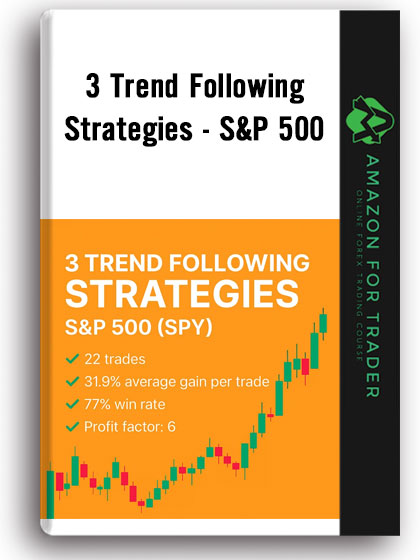
A set of three complementary trend-following strategies with unique entry signals and a shared exit method – all backtested on the SPY ETF tracking the S&P 500.
22 trades
31.9% average gain per trade
77% win rate
Profit factor: 6
7.6% annual return (CAGR)
81% market exposure
Risk-adjusted return: 9.4%
Max drawdown: -35%
You’ll get the full trading rules – ready to test and validate.
Research Questions
This paper investigates how effectively trend-following strategies can manage market risk and improve investment performance. Using historical S&P 500 data, the authors compare simple moving averages, moving average crossovers, and breakout rules with different trading frequencies and stop-loss techniques.
The study addresses five key questions:
- Do more complex trend-following strategies outperform simpler approaches?
- Does trading frequency affect returns and risk-adjusted performance?
- Do frequent trades generate excessive transaction costs?
- Can stop-loss rules help reduce drawdowns and improve results?
- Do trend-following signals outperform traditional valuation metrics?
Key Findings
The results suggest that more complex strategies do not consistently outperform simple moving averages. Although crossover and breakout rules can perform better over shorter periods, they do not reliably beat a buy-and-hold strategy.
Monthly signals generally perform as well as or better than daily signals, offering competitive returns with lower volatility and fewer transaction costs. The study also finds that stop-loss rules provide limited additional benefits, suggesting that following the underlying trend may be more effective than adding separate stop-loss mechanisms.
Longer-term trend-following signals show stronger risk-adjusted performance than shorter-term signals. Compared with traditional valuation metrics, trend-following strategies can reduce volatility by approximately 33%–50% and achieve higher Sharpe ratios.
Why It Matters
The research offers practical guidance for investors and fund managers seeking to manage downside risk. Simple, long-term trend-following strategies can help reduce volatility without requiring complex models or frequent trading. However, the findings are based primarily on historical S&P 500 data, so their effectiveness may vary across markets and future conditions.
3 Trend Following Strategies, S&P 500, Quantified Strategies, Download S&P 500, Free S&P 500, S&P 500 Torrent, S&P 500 Review, S&P 500 Groupbuy, Download Quantified Strategies, Free Quantified Strategies, Quantified Strategies Torrent, Quantified Strategies Review, Quantified Strategies Groupbuy.