

 Grant Noble - The Trader's Edge
 Milton Abramowitz, Irene Stegun - Handbook of Mathematical Functions
 CashFlow Heaven – Trade from Anywhere (tradefromanywhere.com)
 Donald G.Worden - Street-Smart Chart Reading - Volume 1 - The Rudiments
 James Altucher - Trade Like a Hedge Fund
 Austin Passamonte Package ( Discount 25 % )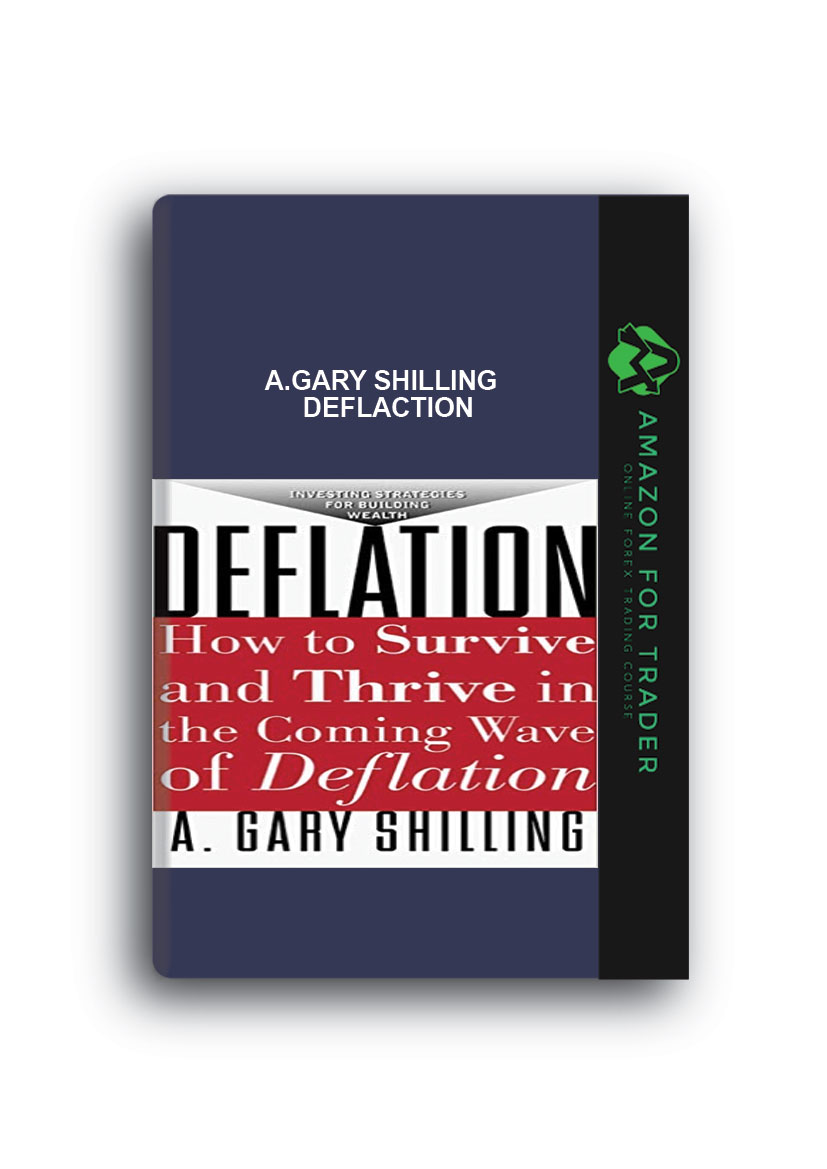
Description
A.Gary Shilling – Deflaction
Although all eyes have been on Southeast Asia since October, it’s not the only game around. A broader look shows that the financial crisis in that part of the world is to global deflation what the 1973 oil embargo was to inflation: it focuses and augments the many forces already at work. For the last two decades, governments, corporations, and new technologies have promoted actions that, given certain triggers, will push prices down.
In his comprehensive new book, Deflation, A. Gary Shilling points out the deflationary forces at work in the world, analyzes the impact of the Asian financial crisis, and predicts the kind of deflation that will likely result.
Governments, for example, have done their part by reducing spending and shrinking deficits. With the Cold War over, US defense spending keeps falling dropping from 7.4% of GDP in the third quarter of 1986 to 4% in the first quarter of 1998. Continental governments endure double- digit unemployment rates to move toward the Maastricht target, deficits no more than 3% of GDP. Deregulation among utilities and services is also lowering prices. In the US, Citizens for a Sound Economy, a Republican think-tank, predicts that deregulation of the electricity market would lead to a drop of “at least 43%” in consumers’ electricity bills.
Meanwhile, central banks are still fighting the last war, inflation, with higher interest rates. Corporations are adding to deflation momentum with the restructuring that started in the US and UK in the 1980s and has spread to other English-speaking lands. Global outsourcing now provides not only less expensive goods but also cheaper services, including credit card processing and computer programming. Computer and information technology has deflation written all over it. Hardware and software are notoriously prone to price cuts, and users buy the stuff to reduce their own costs.
Outside the US, newly industrialized countries as well as countries recently freed from Communism are becoming major players in the export market. The result is a global glut of products and no one to buy them. With Southeast Asia’s financial woes, its consumers are not much of a market, and the US the world’s happy dumping ground can only buy so much. Faced with increasing global glut, countries wanting to use exports to improve their economies are more likely than ever to devalue their currencies. No doubt a strengthening dollar is deflationary to the US, and no doubt it is currently welcomed by Washington. But what happens as global glut and weak US exports meet rising labor costs, spurred by the drum-tight US labor market, head on? What happens if a profit squeeze kills overpriced US stocks, and individual investors who rely on their equity portfolios as their savings accounts suffer big losses?
Consumers retrench. Then they watch prices fall, and in a classic move that makes deflation a self-feeding phenomenon, they wait for prices to go even lower before spending a dime.
If, by some slim chance, the Asian crisis proves to be a nonevent for the US, the Federal Reserve will no doubt tighten credit and probably precipitate a recession, preceded, as usual, by a bear market in US stocks. The net effect on consumer behavior would be the same, and as with the case of an Asian-initiated bear market, the end result would be deflation.
When we in the US think of deflation, we think of the 1930s. Its images of soup lines and shanty towns are so vivid that any other idea of deflation pales by comparison. But there was deflation after the Civil War without the financial collapse of the ’30s. The deflation Dr. Shilling forecasts coming soon is more likely to be characterized by the oversupply of the late 19th century than the unemployment of the Depression.
The final chapters of Deflation explain how deflation will affect you. Should you keep your stock investments or switch to bonds? Will your company need to be restructured again? What should you do about inventories? Have you personally been saving enough? Dr. Shilling gives you 13 investment strategies, 18 business strategies, and five personal strategies that will work in the deflationary years ahead.
Be prepared. In future years we may conclude that in the summer of 1997, Asia was the trigger for global deflation.
A.Gary Shilling, Deflaction, Download Deflaction, Free Deflaction, Deflaction Torrent, Deflaction Review, Deflaction Groupbuy.





Reviews
There are no reviews yet.