

 Carlos Usabiaga Ibanez – The Current State of Macroeconomics
 Cheng-Few Lee – Encyclopedia of Finance
 Craig Bttlc – The Adventures of the Cycle Hunter
 Alpesh Patel Package ( Discount 20% )
 CashFlow Heaven – Trade from Anywhere (tradefromanywhere.com)
 Darrell Duffie – Credit Risk
 TRIFORCE TRAINING Part 2
 Larry Pesavento - Astro Cycles. The Trader's Viewpoint
 Carlos M.Pelaez – The Global Recession Risk
 Craig Harris – Forex Trading Advice & Intro to The Natural Flow (craigharris-forex-education.com)
 David A.Strachman – Funds of Funds Investing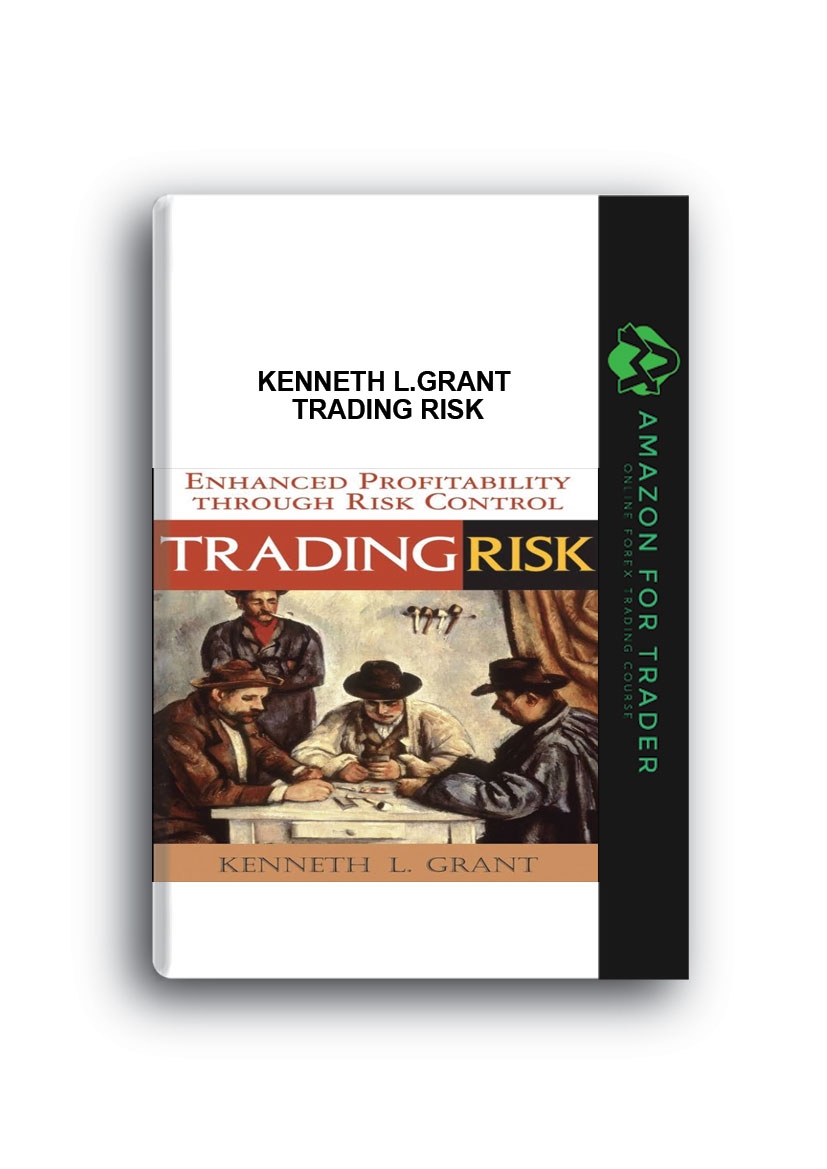
Description
Kenneth L.Grant – Trading Risk
Description
Revolutionary techniques that traders can implement to improve profits and avoid losses
No trader, professional or individual, can afford not to have a solid risk management program integrated into his or her trading system. But finding a precise mathematical model to replace subjective decision-making processes is a challenge. Traditionally, risk management has focused solely on loss avoidance, but in Trading Risk, hedge fund risk manager Kenneth Grant presents some-thing completely new—how to manage a portfolio to minimize risk and increase profits by putting more capital at risk. Trading Risk details a risk management program that can help both money managers and individual traders evaluate which elements in a portfolio are working efficiently and which aren’t. By illustrating an extremely simple set of statistical and arithmetic tools this book can help readers enhance their performance in many financial markets.
Kenneth L.Grant is Cheyne’s Global Risk Manager, and is the Managing Member for Cheyne Capital, LLC, the firm’s U.S. arm. Mr. Grant is a pioneer in the field of hedge fund risk management and capital allocation. Before joining Cheyne, he created risk control programs at two of the world’s leading hedge funds, Tudor Investments and SAC Capital, where he was eventually promoted to the title of Chief Investment Strategist. Mr. Grant holds a Bachelor of Science in Economics and Mathematics from the University of Wisconsin, an MA in Economics from Columbia University, and an MBA from the University of Chicago Graduate School of Business.
Table of Contents
PREFACE.
ACKNOWLEDGMENTS.
CHAPTER 1: The Risk Management Investment.
CHAPTER 2: Setting Performance Objectives.
Optimal Target Return.
Nominal Target Return.
Stop-Out Level.
The Beach.
CHAPTER 3: Understanding the Profit/Loss Patterns over Time.
And Now to Statistics, but First a Word (or More) about Time Series Construction.
Time Units.
Time Spans.
Graphical Representation of Daily P/L.
Histogram of P/L Observations.
Statistics.
A Tribute to Sir Isaac Newton.
Average P/L.
Standard Deviation.
Sharpe Ratio.
Median P/L.
Percentage of Winning Days.
Performance Ratio, Average P/L, Winning Days versus Losing Days.
Drawdown.
Correlations.
Putting It All Together.
CHAPTER 4: The Risk Components of an Individual Portfolio.
Historical Volatility.
Options Implied Volatility.
Correlation.
Value at Risk (VaR).
Justification for VaR Calculations.
Types of VaR Calculations.
Testing VaR Accuracy.
Setting VaR Parameters.
Use of VaR Calculation in Portfolio Management.
Scenario Analysis.
Technical Analysis.
CHAPTER 5: Setting Appropriate Exposure Levels (Rule 1).
Determining the Appropriate Ranges of Exposure.
Method 1: Inverted Sharpe Ratio.
Method 2: Managing Volatility as a Percentage of Trading Capital.
Drawdowns and Netting Risk.
Asymmetric Payoff Function.
CHAPTER 6: Adjusting Portfolio Exposure (Rule 2).
Size of Individual Positions.
Directional Bias.
Position Level Volatility.
Time Horizon.
Diversification.
Leverage.
Optionality.
Nonlinear Pricing Dynamics.
Relationship between Strike Price and Underlying Price (Moneyness).
Implied Volatility.
Asymmetric Payoff Functions.
Leverage Characteristics.
Summary.
CHAPTER 7: The Risk Components of an Individual Trade.
Your Transaction Performance.
Key Components of a Transactions-Level Database.
Defining a Transaction.
Position Snapshot Statistics.
Core Transactions-Level Statistics.
Trade Level P/L.
Holding Period.
Average P/L.
P/L per Dollar Invested (Weighted Average P/L).
Average Holding Period.
P/L by Security (P/L Attribution).
Long Side P/L versus Short Side P/L.
Correlation Analysis.
Number of Daily Transactions.
Capital Invested.
Net Market Value (Raw).
Net Market Value (Absolute Value).
Number of Positions.
Holding Periods.
Volatility/VaR.
Other Correlations.
Final Word on Correlation.
Performance Success Metrics.
Methods for Improving Performance Ratios.
Performance Ratio Components.
Maximizing Your P/L.
Profitability Concentration (90/10) Ratio.
Putting It All Together.
CHAPTER 8: Bringin’ It on Home.
Make a Plan and Stick to It.
If the Plan’s Not Working, Change the Plan.
Seek to Trade with an “Edge”.
Structural Inefficiencies.
Methodological Inefficiencies.
Play Your P/L.
Avoid Surprises—Especially to Yourself.
Seek to Maximize Your Performance at the Margin.
Seek Nonmonetary Benefits.
Apply Liberal Doses of Humility and Humor.
Be Healthy/Cultivate Other Interests.
APPENDIX: Optimal f and Risk of Ruin.
Optimal f.
Risk of Ruin.
INDEX.
Author Information
Kenneth L.Grant is Cheyne’s Global Risk Manager, and is the Managing Member for Cheyne Capital, LLC, the firm’s U.S. arm. Mr. Grant is a pioneer in the field of hedge fund risk management and capital allocation. Before joining Cheyne, he created risk control programs at two of the world’s leading hedge funds, Tudor Investments and SAC Capital, where he was eventually promoted to the title of Chief Investment Strategist. Earlier in his career, Mr. Grant led risk management efforts for the Chicago Mercantile Exchange and Société Générale. He is also a member of the Board of Directors of the Managed Futures Association (MFA), and is a founding member of MFA’s Hedge Fund Advisory Committee–the industry’s leading trade relations organization. He is a principal author of MFA’s Sound Practices for Hedge Fund Managers (2000). Mr. Grant holds a Bachelor of Science in Economics and Mathematics from the University of Wisconsin, an MA in Economics from Columbia University, and an MBA from the University of Chicago Graduate School of Business.
Kenneth L.Grant, Trading Risk, Download Trading Risk, Free Trading Risk, Trading Risk Torrent, Trading Risk Review, Trading Risk Groupbuy.



Reviews
There are no reviews yet.