Description
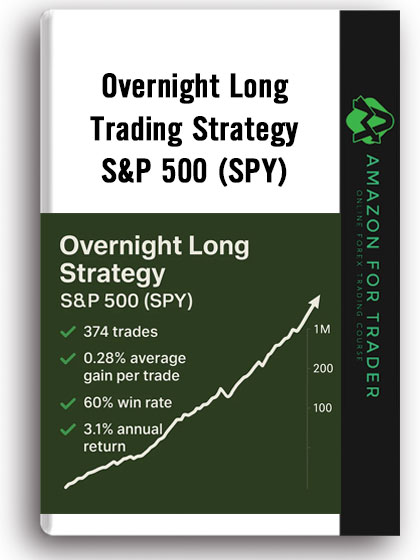
A backtested swing trading strategy that enters at the close and exits at the close of the next day. Built using three variables for entry and one for exit, tested on SPY – the ETF tracking the S&P 500.
- 374 trades
- 0.28% average gain per trade
- 60% win rate
- Profit factor: 1.6
- 3.1% annual return (CAGR)
- Only 5% market exposure
- Risk-adjusted return: 68%
- Max drawdown: -16%
You’ll get the full trading rules – ready to test and validate.
SPDR S&P 500 ETF Trust (SPY) is one of the most actively traded ETFs, offering high liquidity and opportunities for both day traders and long-term investors. Understanding its intraday volatility can help traders make more informed decisions.
Key Volatility Patterns
Historical data across 7-day, 30-day, 100-day, and 365-day periods reveals several recurring patterns:
- Market Open (9:30–10:30 AM ET): Consistently the most volatile period, as traders react to overnight news and new market orders.
- Mid-Morning (10:30–11:30 AM ET): Price movements may become more stable as the day’s trends develop.
- Early Afternoon (1:00–2:00 PM ET): Often quieter, with potential opportunities to follow established trends.
- Market Close (3:00–4:00 PM ET): Trading activity may increase as investors adjust or close positions.
The opening bell showed the highest average price changes across all four historical periods, while the 100-day analysis also identified increased volatility near 3:50 PM ET.
Factors Influencing SPY Volatility
SPY’s price movements are influenced by several factors, including:
- Economic data and Federal Reserve decisions.
- Inflation and interest rate expectations.
- Market sentiment and changes in the VIX.
- Global economic developments and geopolitical events.
- Trading volume and activity in major S&P 500 companies.
Strategies for Analyzing SPY
Traders can combine technical indicators, volume analysis, market sentiment, and fundamental research to identify potential entry and exit points. However, higher volatility can create both opportunities and greater risk.
Effective risk management—including appropriate position sizing and stop-loss planning—is essential. Historical patterns can provide useful context, but they do not guarantee future price movements or profitable trades.
Disclaimer: This article is for informational purposes only and does not constitute financial advice. Always conduct your own research before making investment decisions.
About the salepage
Quantified Strategies is a trading and investment research platform founded in 2012 by experienced traders Oddmund Groette and Håkan Samuelsson. The platform focuses on evidence-based market research, backtested trading strategies, and systematic investing. Through historical data, statistical analysis, and practical educational resources, it helps traders make more informed decisions and develop disciplined, data-driven trading approaches.
Overnight Long Trading Strategy, S&P 500 (SPY), Quantified Strategies, Download S&P 500 (SPY), Free S&P 500 (SPY), S&P 500 (SPY) Torrent, S&P 500 (SPY) Review, S&P 500 (SPY) Groupbuy, Download Quantified Strategies, Free Quantified Strategies, Quantified Strategies Torrent, Quantified Strategies Review, Quantified Strategies Groupbuy.