

 Raymond Merriman – The Ultimate Book on Stock Market Timing (VOL II) – Geocosmic Correlations to Investment Cycles
 Stephen W.Bigalow – Advanced Pattern Analysis
 John Carter - Mastering the Trade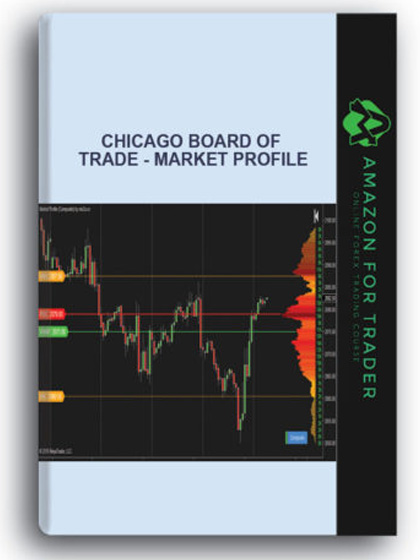
Description
Chicago Board of Trade – Market Profile
A Market Profile is an intra-day charting technique (price vertical, time/activity horizontal) devised by J. Peter Steidlmayer, a trader at the Chicago Board of Trade (CBOT), ca 1959-1985. Steidlmayer was seeking to evaluate market value as it developed in the day time frame. Steidlmayer’s charts displayed a bell shape, fatter at the middle prices, with activity trailing off at the higher and lower prices. In this structure he recognized the ‘Normal’, gaussian distribution he had met with in college statistics, (3).
The Market Profile graphic was introduced to the public in 1985 as a part of a CBOT product, the CBOT Market Profile (CBOTMP1) (2). CBOTMP1 included the new Liquidity Data Bank (LDB) data; end-of-day clearings, identified by the class of trader in the pits ( (1) local, (2) commercial, (3) members filling for other members and (4) members filling orders for the public). The Profile was proposed as a tradingmethodology for using these new data. CBOTMP1 advertised the Profile/LDB as the way to ‘Improve Performance’. It is described as “the only variable-cost ticker service in the commodities industry.”
The promotional material says the Profile is to be the link between the CBOT data and the market. A Profile graphic is to be used to tell “what the market is doing”; the LDB data is for finding the market’s ‘condition’. As a part of the data-display connection in CBOTMP1, the price of the peak cleared volume is identified as the Point of Control (POC). Following the normal distribution analogy, the central seventy percent of trading activity about POC (+/- one standard deviation) is termed the ‘Value Area’.
Section Headings for “CBOT Market Profile, 1986” are:
- Using the CBOT Market Profile to Improve Performance
- The Profile: The link Between CBOT Data and the Market
- Part I What the Market is Doing: The Market Profile Graphic
- Part II The Condition of the Market: Liquidity Data Bank
- Appendix
In 1987, Professor Thomas P. Drinka of Western Illinois University launched the first Market Profile® course in academia. As of 2010, Western remains as the premiere and only academic institution to offer such a course as part of curriculum.
A new and expanded 335 page CBOT Market Profile manual, CBOTMP2, was released in 1991, (5). In this volume the first five sections are devoted to profile analysis. The last section discusses LDB data. Unlike CBOTMP1, there is no emphasis on a Market Profile ticker product. In the period 1985 – 1991 the profile concept caught on with the public (in one Chicago Tribune article Steidlmayer was identified as “the man who knows where the market is going”).
Steidlmayer and Kevin Koy started Market Logic School to teach profile trading. CBOT gave up on marketing the Liquidity Data Bank directly to the public (CISCO Futures became their vendor). Public access to tick data increased greatly so that profiles could be constructed intra-day (LDB data was still end of day). It was becoming clear that pit trading‘s days were numbered. By 1991 it was obvious that the focus was on the profile technology and less on the database used to support the calculations. Hence the change in emphasis on the Profile vs the LDB data in CBOTMP2.
In both CBOTMP1 and CBOTMP2 ‘Market Profile’ occurs in the name, but it is hard to find a definition of exactly what a Market Profile is. Many, many examples are given in both publications. A working definition from Mind Over Markets (9) is: “the market’s price activity recorded in relation to time in a statistical bell curve“. Added to this would be a definition of the price and the marker, a ‘TPO’ (time-price opportunity), with TPO defined in CBOTMP1 as: “opportunity created by the market at a certain price at a certain time”. For example:
101150 A A = 08:00 to 08:29101125 AB B = 08:30 to 08:50101100 B C = 09:00 to 09:29101075 BC
Letters identify time, as does position (A’s in one column, B’s in the next, etc. A, B, C are TPO’s (that price occurred).
Section Headings for “CBOT Market Profile, 1991”
- Reading the Market Profile Graphic
- Profiles for Long Term Trends
- Perception of Value Fuels Market Activity
- Market Profile Data and the Distribution Process
- Market Profile Tools to Support Trading Decisions
- Liquidity Data Bank Volume Analysis
Volume is said to identify signs of continuation or change, to infer the directional facilitation of trade, but “volume data, by itself, is meaningless”. The reason given is that “it is essential to know what market participants are doing”. Many ‘profile readings’ are shown in both CBOTMP1 and CBOTMP2, inferring who is trading what and what message they are sending. One method, apparently, is to see if volume is increasing to the upside or downside intra-day. It should be noted that the LDB data discussed here is end of day. Some time later the CBOT began releasing clearings during the day on the half hour. These clearings when compared to tick data indicate an approximately half hour delay. It is not explained just how reading trade facilitation with delayed data is effected.
At the beginning of the day the first hour of trading creates a range (the Initial Balance). Then, as additional information on the day’s trading continued, certain chart formations, called day types, are recognized. These formations have names (1), (2), such as ‘neutral day’, non-trend day, trend day, etc. Another concept, the ‘third standard deviation’ or Steidlmayer Distribution has been discussed (1) possibly in support of day types. The Steidlmayer Distribution begins as the current, equilibrium, distribution moves out of equilibrium (1, p 175).
Chicago Board of Trade, Market Profile, Download Market Profile, Free Market Profile, Market Profile Torrent, Market Profile Review, Market Profile Groupbuy.





Reviews
There are no reviews yet.